Alumni lead dialogue on expanding access to climate finance
Posted: 5 December 2025
On 6 November 2025, Australia Awards – South Asia & Mongolia’s Champions for the Environment and Climate Action alumni network hosted an online discussion about accessing climate finance to support climate-resilient development across South Asia and Mongolia. The event brought together alumni who are working as development practitioners or sector professionals to explore practical pathways for mobilising finance and fostering innovation in climate action.
The session was moderated by Oyundelger Enkhtuvshin, an Australia Awards alumna from Mongolia who specialises in socio-environmental development and climate resilience. In her opening remarks, Oyundelger highlighted the urgency of strengthening inclusive climate finance systems that support vulnerable communities, noting that climate investments must be “grounded locally, yet informed by regional collaboration”. The event featured presentations from two distinguished alumnae who are leading climate finance initiatives in their countries: Mehak Masood from Pakistan (who is a National Project Officer for Climate Change at the United Nations’ International Organization for Migration in Pakistan and the founder of Green Women Pakistan) and Chuluunkhuu Baatar from Mongolia (who is a climate finance expert and Green Climate Fund Liaison Officer for Mongolia).
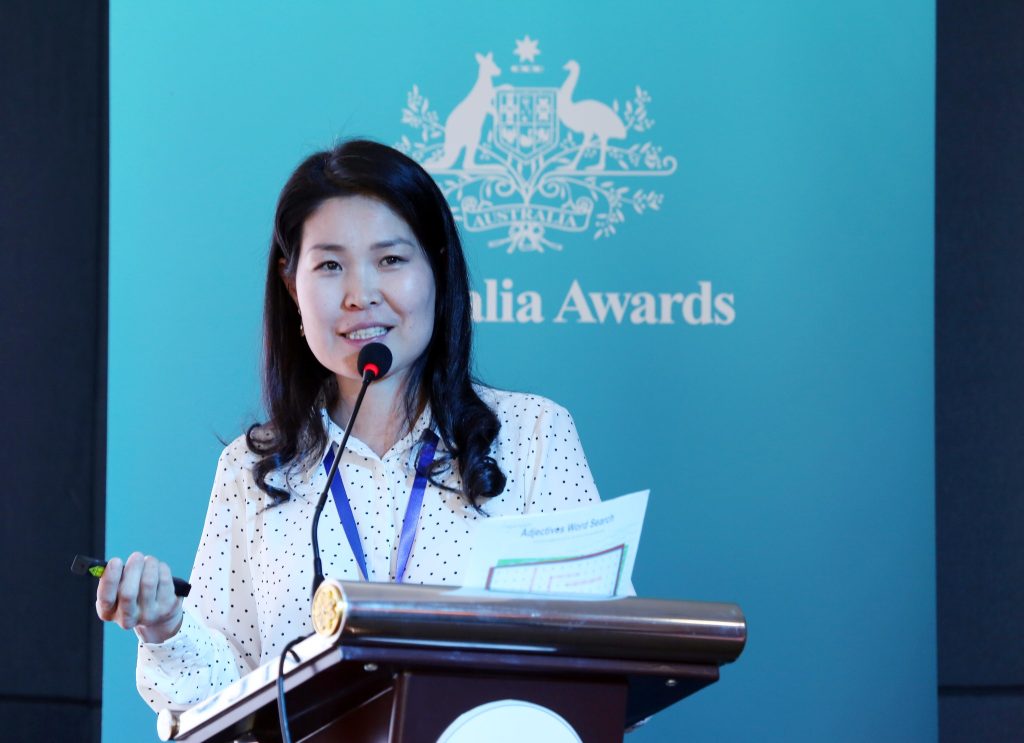
Oyundelger presenting her work at the 2023 Regional Alumni Workshop in Mongolia on the theme ‘Building Back Better: Climate Resilience and Green Economic Recovery’.
Mehak’s presentation focused on unlocking opportunities for climate-resilient and equitable development. Drawing on more than 15 years of experience in government departments, United Nations agencies and the private sector, Mehak provided a practical overview of the evolving climate finance landscape in South Asia. She emphasised three major shifts that are taking place: from standalone projects to integrated systems; from public funding to blended finance models, where public funds are paired with private investment to encourage ownership and scalability; and from ‘one-size-fits-all’ to localised, community-driven adaptation.
Regarding integrated systems, donors increasingly expect climate projects to demonstrate long-term sustainability, clear co-benefits, and measurable social and environmental impact. Mehak also shared insights from Pakistan’s emerging blended finance and climate innovation lab approach, highlighting growing interest in impact investing, climate-focused startups, and blue and green bonds supporting nature-based solutions. In addition, she emphasised that effective climate finance must include gender equality, indigenous knowledge and youth engagement, alongside strong data systems. Her team’s recent work includes developing climate vulnerability assessments with a human mobility lens, starting in coastal regions and expanding nationwide. She concluded by encouraging alumni to collaborate on proposals that are innovative, inclusive and measurable, noting that “climate finance must translate into real resilience and opportunities for those most affected”.
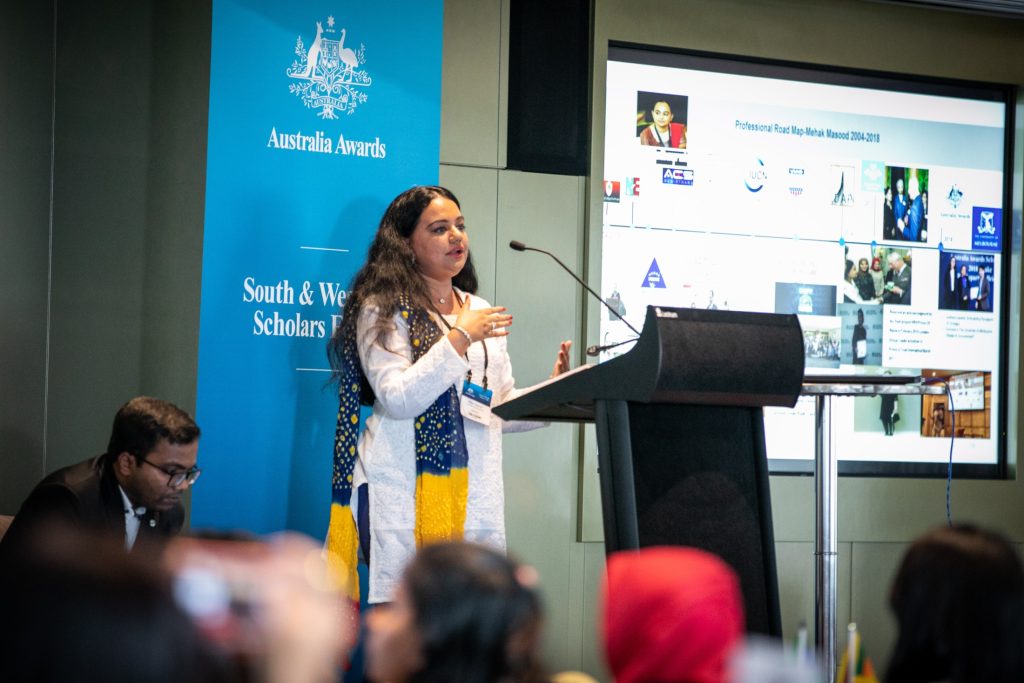
Mehak presenting her work as a scholar at the 2018 South and West Asia Scholars Forum during her time in Australia.
Chuluunkhuu spoke about policy instruments used to accelerate climate action. She reflected on Mongolia’s climate finance journey since the Paris Agreement, noting that although significant funding has been accessed through mechanisms such as the Green Climate Fund and the Adaptation Fund, challenges remain around transparency, implementation speed and ensuring that local stakeholders benefit. To address this, Mongolia is now moving towards three major goals: establishing carbon market readiness, creating the Mongolia Green Finance Corporation, and developing a national climate investment and coordination platform. A new national climate change law is under development to enable transparent Article 6 carbon transaction systems.
Chuluunkhuu stressed that carbon markets must be trust-based, accountable, and inclusive of the private sector and civil society. The Mongolia Green Finance Corporation, established through equity investment by the Green Climate Fund, is another mechanism that will mobilise diverse green funding sources, support businesses in adopting low-carbon models and strengthen the long-term sustainability of national climate policies. Development of a national climate investment and coordination platform has been inspired by international examples. The platform will consolidate climate finance project information; track implementation and impact; match projects with potential investors; and improve coordination across government ministries, banks, non-government organisations and private companies. She further emphasised that “partnership is the key to unlocking climate finance at scale”, highlighting collaboration models such as Denmark’s climate partnership approach as inspiration.
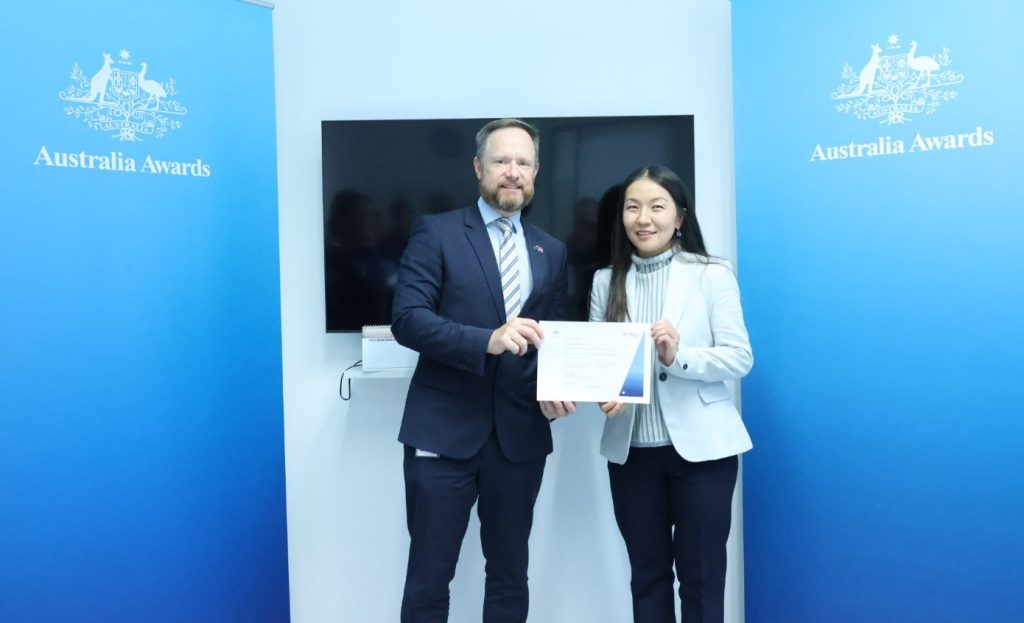
Chuluunkhuu receiving her certificate for completing the Australia Awards Regional Short Course on ‘Accessing Climate Finance’ from Andrew Berryman, the Deputy Head of Mission at the Australian Embassy in Mongolia.
A Q&A segment of the discussion offered the attending alumni an opportunity to reflect on how they can practically apply the climate finance approaches discussed during the session within their own country contexts. Participants raised questions about navigating complex funding requirements; building credibility with donors; and forming partnerships across the government, private sector and community organisations. Several alumni emphasised the need for stronger knowledge-sharing networks to support proposal development and monitoring frameworks. The speakers highlighted that meaningful progress requires patience, collaboration and clear communication with stakeholders at every level. The discussion also highlighted that alumni are well-positioned to drive locally-grounded climate solutions when supported by accessible resources and sustained peer connection.
Reflecting on the alumni panel, Mongolian alumnus Tuvshinbagana Munkhjargal said, “The panel reinforced that climate finance is most impactful when aligned with local contexts and grounded in strong public–private collaboration. Mongolia’s emerging carbon market and green finance ecosystem show that even small economies can lead in innovative climate solutions.”
The Champions for the Environment and Climate Action alumni network is a dynamic, member-led initiative under Australia Awards – South Asia & Mongolia. It brings together alumni who are committed to environmental protection, climate resilience and sustainable development across the region. Through collaboration, innovation and shared leadership, this network amplifies the role of alumni as changemakers in addressing one of the most urgent challenges of our time.