

Alumni learn about advancing women-led climate action and inclusive leadership
Posted: 8 March 2026
In advance of International Women’s Day 2026, more than 90 Australia Awards – South Asia & Mongolia alumni gathered online to explore the role of women-led climate action and inclusive leadership in strengthening community resilience across the region.
The session on 26 February was jointly hosted by the Program’s four regional alumni networks—Regional Women in Leadership Network, Male Allies for Gender Equality, Equity for All, and Champions for Environment and Climate Action—reflecting a shared commitment to advancing gender equality, climate justice and inclusive development.
The session was moderated by Indian alumna Ashwarya Tyagi, a member of the Equity for All alumni network and an architect and urban planner who works at the intersection of gender, clean energy and public health. Ashwarya welcomed keynote speaker Clare Gibellini, a disability and human rights advocate with lived experience of multiple disabilities, including autism. Clare is Chair of the National Disability Research Partnership and former Co-Chair of the Oversight Council for Australia’s first National Autism Strategy. She is also a board member of the Centre for Australian Progress, Chair of the Western Australian Ministerial Advisory Council on Disability and an emergency services volunteer who helps build community resilience. Internationally, she represented Australia at the United Nations Conference of State Parties from 2022 to 2025 and at the Commission on the Status of Women from 2024 to 2025, advocating for inclusive approaches to disaster risk, climate action and gender equity.

Alumna Ashwarya Tyagi participating at the Regional Alumni Workshop held in Colombo in 2025.
In her keynote remarks, Clare highlighted that climate change is not gender-neutral and that it disproportionately affects women and girls, particularly women with disability, through increased exposure to food insecurity, displacement and climate-related health risks. However, she emphasised that women, in addition to being among those most affected, are also central to effective climate solutions. Organisations and governments with greater representation of women in leadership adopt stronger and more integrated climate and sustainability commitments.
Across South Asia and Mongolia, this leadership is already visible in women coordinating disaster responses, leading climate-smart agriculture initiatives and sustaining community safety nets. “These are not side projects,” she said. “They are critical climate infrastructure and deserve recognition, influence and resourcing.”
A central theme of the keynote remarks was the shift from participation to power-sharing. Clare highlighted that climate justice requires governance systems where women, Indigenous communities, people with disability and other marginalised groups not only are consulted but share decision-making authority. Clare stressed that designing with those most affected leads to more effective and scalable solutions. “If we include communities from the beginning, we build systems that work for everyone,” she said.
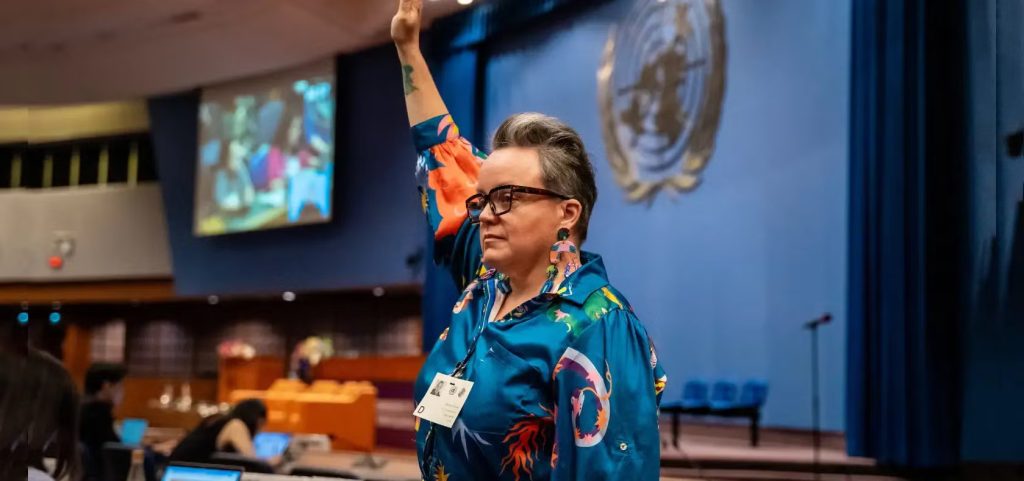
Clare Gibellini stands in the main conference during the Ministerial Conference. Photo courtesy: UN Women/Ploy Phutpheng
Another key focus of the session was the leadership of women with disability in climate action. Clare challenged the perception of people with disability as inherently vulnerable, highlighting their roles as organisers, innovators and community leaders. She shared examples of disability-led climate initiatives that have reshaped national climate discussions, demonstrating that relatively small investments in disability leadership can catalyse broader systemic change. She noted that inclusive design benefits many groups, including older people, injured individuals and families with young children, strengthening resilience for entire communities.
Clare’s remarks concluded with concrete recommendations for alumni working across government, civil society, academia and the private sector. These recommendations included designing climate initiatives with communities, not for them; measuring success through participation and leadership outcomes, not only outputs; scaling successful pilots into institutional pathways; investing in regional networks and coalitions of women and disability leaders; and embedding gender-responsive and disability-inclusive climate governance in policy and law. Clare emphasised that local governance is often where climate justice is realised or denied, calling for stronger local capacity, inclusive data and participatory planning.
The session concluded with a lively Q&A with alumni. From grassroots climate action to national policy and regional collaboration, this discussion highlighted that alumni across the region are advancing inclusive solutions to shared climate challenges.
Reflecting on the event, Bangladeshi alumna Ivy Tisha said, “Clare’s real-life examples were truly inspiring, especially in showing how women with disability can lead and create meaningful impact in climate action. Her story reminded us that inclusive leadership is not just a concept, but a lived reality.”