

Scholars participate in photo competition on ‘Learning from First Nations Australians’
Posted: 12 August 2026
Between NAIDOC Week and International Day of the World’s Indigenous Peoples, Australia Awards scholars submitted entries to the Through My Eyes: Learning from First Nations Australians photo competition. The competition invited scholars to submit a photograph and reflection showing what they had learnt about First Nations peoples, cultures and communities during their time in Australia.
The winner was announced during a scholar webinar to mark International Day of the World’s Indigenous Peoples. Australia Awards – South Asia & Mongolia’s Indigenous Engagement Adviser, Alice Tamang, a Dharug woman, said the judging panel had been impressed by the strength of the entries and the thoughtful ways scholars connected their learning in Australia with their own cultures, studies and families.
The winner was Rajeeka Ranathunga Jayasekara Koralalage from Sri Lanka. Rajeeka’s photograph showed the Quandamooka Truth Embassy at Minjerribah in Queensland, which she encountered during a field trip for her studies. Alice said the judges were particularly moved by Rajeeka’s curiosity to keep learning, her reflections on truth-telling and cultural resilience, and her commitment to sharing these stories with her children.
Speaking after the announcement, Rajeeka said she had not taken the photograph with a competition in mind, but felt drawn to the site as “a place of freedom” where people could speak, negotiate and tell their truth. She said that learning about First Nations histories and experiences had resonated with her own background, given that Sri Lanka is also an island nation with a history of colonisation and resilience. As a mother of two, Rajeeka said she values passing this learning on to the next generation, adding that she and her children often talk about First Nations cultures and histories at home.
Rajeeka’s winning entry and those of the three other finalists are repeated in full below, along with excerpts of other scholars’ entries.
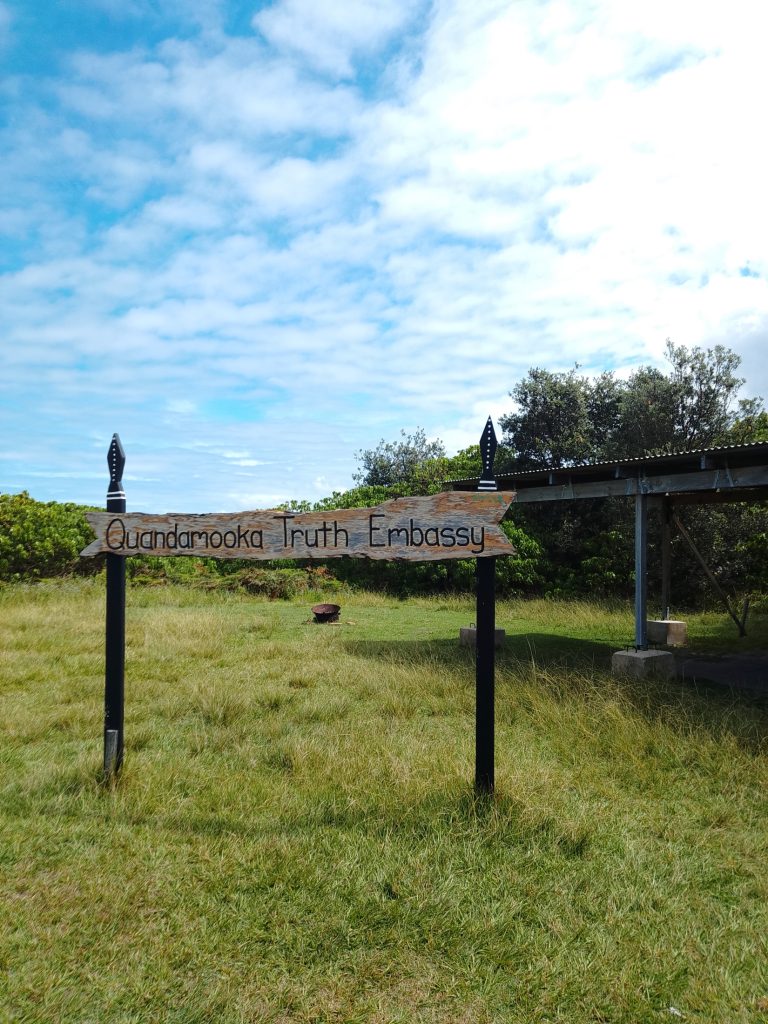
The winning photo of scholar Rajeeka Ranathunga Jayasekara Koralalage from Sri Lanka.
Caption: Standing on open grassland, the wall-less Quandamooka Truth Embassy on Minjerribah symbolises the idea that truth lives in the open, carried by community, and protected through dialogue and negotiation.
Reflection: I visited Minjerribah on 17 March 2026 as part of a field trip for my Master of Tourism, Hotel and Event Management. We first went to the museum, where we learnt about the history of the First Nations of Australia and of this island. Later, we completed the Gorge Walk.
During the walk, I came across a place called the Quandamooka Truth Embassy. I was curious about it and took this photo on my phone. The words ‘Truth Embassy’ caught my attention, and I learnt that this was a place where First Nations people gather to speak the truth and protect their island. Seeing it reminded me of Somebody’s Land by Adam Goodes, David Hardy and Ellie Laing, a book my children borrowed from their school library. Reading it with my kids, I learnt about the hardships First Nations people endured and the sacrifices they made for this land.
Coming from a country ruled by the Portuguese, the Dutch and the British for centuries, I have heard stories of our own ancestors who sacrificed their lives, fought for our land and stood resilient. Standing at the Truth Embassy enriched my respect for First Nations people, because I understood what it means to lose cultural traditions and what it takes to restore them. The embassy, with no walls, symbolises that there are no limitations when standing up for what is right and speaking the truth. The word ‘embassy’ also reflects diplomacy: resolving disputes through discussion and peaceful means. This gave me more understanding of First Nations people, who are courageous, resilient and diplomatic. I will carry this understanding into my tourism studies and future work, approaching First Nations culture and Country with respect. I will also continue reading these stories with my children, so they grow up knowing the history of the land that has shaped all our lives.
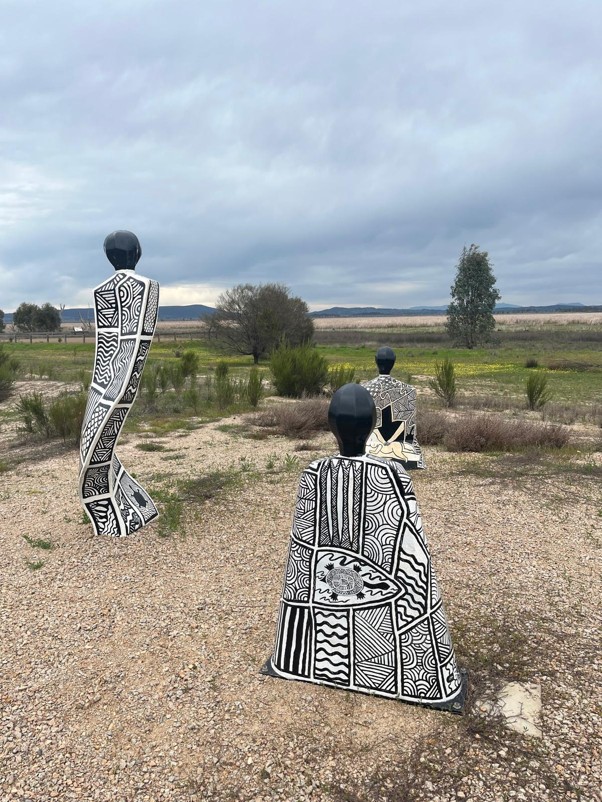
Photo submitted by Nepali scholar Jyoti Ghimire.
Caption: Observing these sculptures, I learnt about the deep connection between First Nations people and their culture, Country and nature. It helped me appreciate the significance of family, ancestorial knowledge, and their stories and long-lasting relationship with the living environment, expressed through the art. It further increased my respect for Indigenous knowledge.
Reflection: I visited the Lotjpatj Natjan Danak Sculpture Walk at Winton Wetlands for an ‘Ecological Restoration’ field trip as part of one of my courses in 2025. We had a brief presentation about the history of that area, the sculptures and the restoration project implemented there. I came across the Yakapna sculptures, which were very eye-catching and immediately caught my attention. It was a powerful experience of learning about Aboriginal living culture, rich history and Indigenous art. I was highly impressed by understanding what the sculptures expressed to visitors.
These three sculptures represent Ancestors, totems, ceremonies, ecology and species, and rivers and creeks for the Yorta Yorta community. It looked like three people were watching towards the wetlands and the beautiful landscape. These sculptures were known as Yakapna, meaning ‘family’ in the Yorta Yorta language. This simple word made me think about how family extends beyond people to include Country, culture and future generations. I learnt that long-necked turtles were a totem that indicated healthy wetland. Moreover, baby cradling on the knee was indicating a symbol of love for the family. Every pattern and linework in the sculptures illustrated what activities were done in that area. Understanding these sculptures closely encouraged me to appreciate the knowledge and cultural values of Aboriginal people and their special places.
Studying the Yakapna, I learnt how the First Nations people used to take care of their family, land and local species. Additionally, this sculpture broadened my knowledge about this Country, which is a source of identity and responsibility to the First Nations people. I realised that caring for Country involves respecting the culture, art and knowledge that the First Nations people have passed down for millennia. While working in conservation and management of forest and land resources in Nepal, I will always respect the knowledge and values that Indigenous people hold for environment.
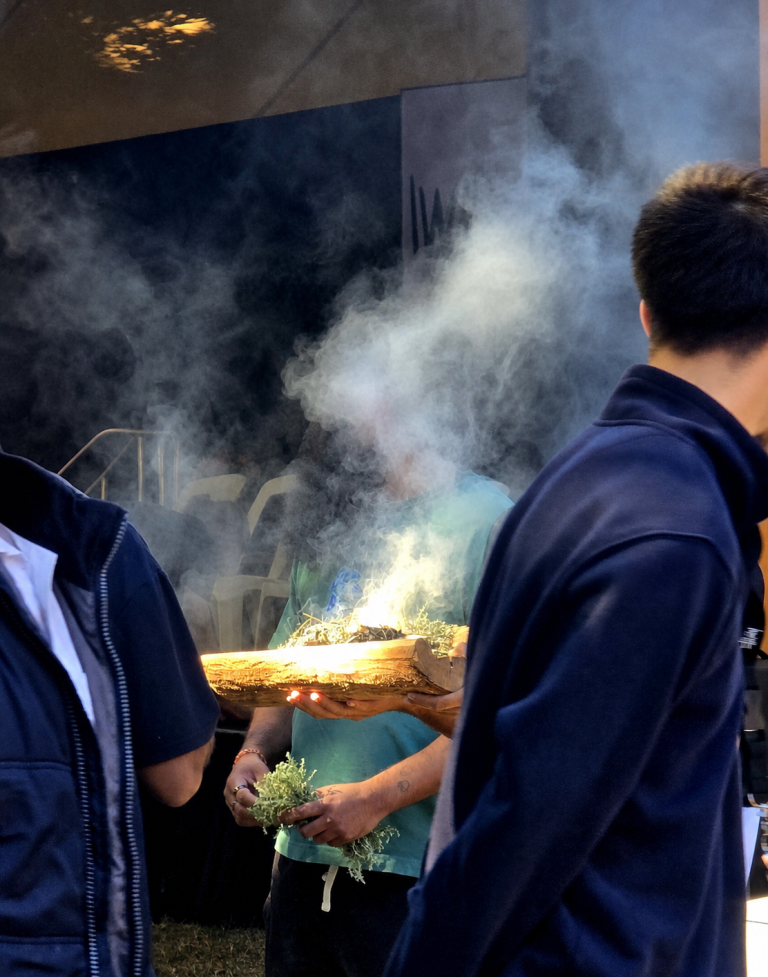
Photo submitted by Md Ahsanul Kabir from Bangladesh.
Caption: Smoke rises during the Kaurna Day smoking ceremony at Adelaide University, where I volunteered for the day. As participants gathered respectfully, I witnessed living Kaurna culture creating a powerful moment of welcome, reflection and connection on Kaurna Country.
Reflection: I took this photograph while volunteering at Kaurna Day at Adelaide University. As smoke from the native plants moved through the gathering, people paused and participated respectfully. The light passing through the smoke first caught my attention, but what lingered was the atmosphere of connection and shared respect.
Volunteering allowed me to contribute to the event while learning through participation. The experience strengthened my understanding that Kaurna culture is not only part of South Australia’s history; it is also a living culture, maintained and shared by Kaurna people on their Country. The ceremony encouraged me to recognise the cultural knowledge and authority of the Traditional Custodians.
I also learnt to think more deeply about the importance of place. Adelaide University’s City East campus stands on Kaurna Country, and witnessing the ceremony made that relationship feel more grounded and meaningful to me. It reminded me that an Acknowledgement of Country should be more than a familiar statement. It should encourage us to learn about the Traditional Custodians, respect their continuing connection to Country, and consider our responsibilities while living and studying on their land.
Through volunteering that day, I learnt that genuine cultural engagement begins with humility, attentive listening and a willingness to build respectful relationships. This photograph represents the moment when that lesson became visible to me through smoke, light and community.

Photo submitted by Nadunie Thathsaranie Wanigasinghe from Sri Lanka.
Caption: This photograph shows dried leaves I painted at the NAIDOC Week gathering at the University of Melbourne, before we walked together to the NAIDOC March to celebrate culture, community and connection.
Reflection: The leaf painting activity was an opportunity for me to meet staff from the Mabo Centre and members of the university’s Indigenous community. Art opens space for connection. Our conversations began with shared interests, including handmade jewellery, and developed into a discussion about jewellery used within different First Nations communities. The leaf painting activity left me curious about the knowledge beneath its surface. What materials and pigments have First Nations artists traditionally used? Are there specific reasons for the selections? Do patterns relate to stories or places? What knowledge can be shared publicly, and who has the cultural authority to teach it?
This curiosity led me to the Koorie Heritage Trust later that day. While immersing myself in the delicate artwork of Gunditjmara Elder Aunty Connie Hart, I learnt that she developed her weaving knowledge by quietly observing her mother and Elders and “sneaking a stitch or two.” Her story also highlighted the vulnerability of intergenerational cultural transmission when opportunities to teach and learn are disrupted.
It reminded me of my maternal grandmother, who was highly skilled in beeralu, Sri Lanka’s traditional bobbin lace making. My mother knows it to some extent, but I cannot do it. This relates not only to me but to many in my generation and generations forward. Although the cultural histories are different, the missing link within my own family helped me understand how valuable artistic knowledge can weaken between generations.
I learnt that an artistic tradition is not preserved merely by displaying. It lives when its rightful custodians can practise, explain and pass on the knowledge behind it.
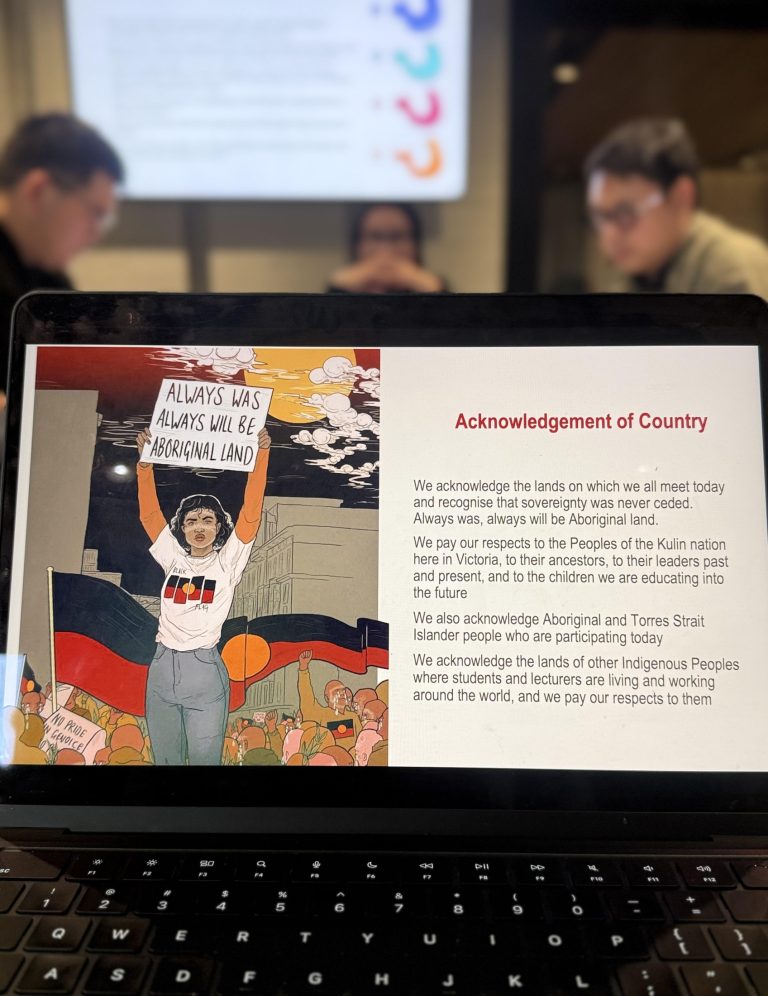
Photo submitted by Bhutanese scholar Sherab Jatsho.
Caption: An Acknowledgement of Country before class became more than a customary opening. It was an invitation to recognise the enduring connection of First Nations peoples to Country and to reflect on how truth, respect and reconciliation can enrich education and strengthen our shared humanity.
Excerpt from reflection: This photograph was taken at the beginning of one of my classes at Monash University during NAIDOC Week. What initially appeared to be a routine opening slide gradually became a profound learning experience and reflection. … The photograph symbolises the power of education to foster understanding across cultures. … Meaningful education extends beyond textbooks; it shapes values, empathy, and our capacity to engage respectfully with different histories, societies and perspectives. This experience has strengthened my appreciation for Indigenous knowledge systems and reinforced the importance of promoting inclusive, respectful and culturally responsive learning environments wherever I may serve in the future.

Photo submitted by Babu Marma from Bangladesh.
Caption: Dharawal Community leader Uncle Shayne tells their ancestors’ stories of land, sea, water and trees on the bank of Kamay Botany Bay National Park.
Excerpt from reflection: Dr Shayne T. Williams, a Dharawal and La Perouse Aboriginal Elder, an educator, and the Chair of the Burraga Foundation, shared the deep connection between the Dharawal and Eora peoples and Kamay (Botany Bay). Through stories of the land, sea, waterways and native plants, he explained how Country is connected to culture, identity and community. I learnt about the Gadigal people, their enduring connection to the area, and the ways they have cared for and lived with Country for generations. We also learnt about the traditional uses of native plants, including cabbage tree palms and bracken fern.
One story that particularly stayed with me was that of Bouri Bouri, the whale, which helped me better understand the deep connection between the sea and the cultural identity of the Eora people. This experience strengthened my appreciation of First Nations knowledge, storytelling traditions, and the enduring relationship between people and Country.
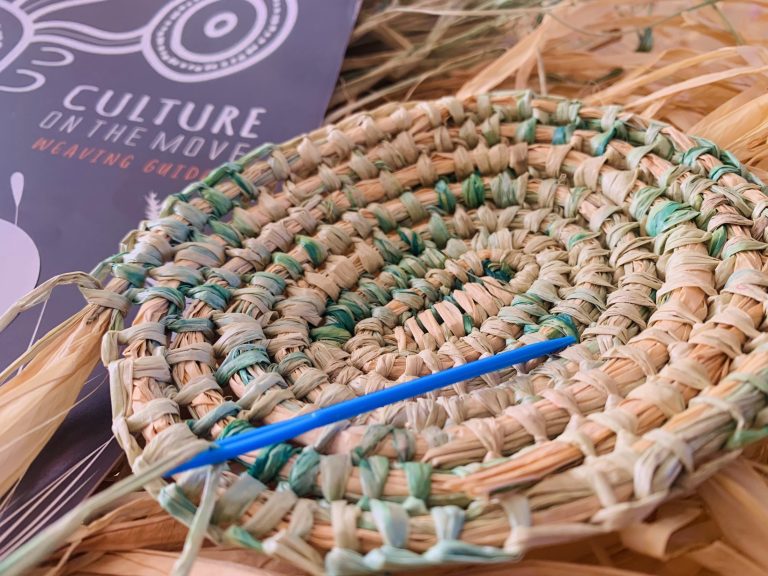
Photo submitted by scholar Dhananjani Pushpamali from Sri Lanka.
Caption: The first stitches of a raffia basket mark the beginning of my learning journey into the artistic traditions of First Nations peoples, revealing how weaving connects culture, storytelling, ancestral knowledge and a deep relationship with Country.
Excerpt from reflection: This photograph captures the very beginning of a basket that I started weaving during the workshop facilitated by Ronnie Jordan, a Pitta Pitta Wangkamahdla woman, the owner of Culture on the Move, a weaver, an artist and a community cultural facilitator. The unfinished base, the heart of the basket, raffia, needle and weaving guide reflect the beginning of my understanding of First Nations Australians, their art, cultural practices and ways of knowing. While the basket is only partially woven, it symbolises the first steps of a much deeper learning journey. … Through listening, learning and engaging with Ronnie, I realised that weaving is a way of sharing stories, preserving cultural identity, empowering community and strengthening the connection to Country. … This experience encouraged me to look beyond the finished artwork and appreciate the knowledge, cultural identity, storytelling tradition and connection to Country woven into every piece. It has strengthened my respect for First Nations cultures and inspired me to continue learning from the world’s oldest continuing cultures.
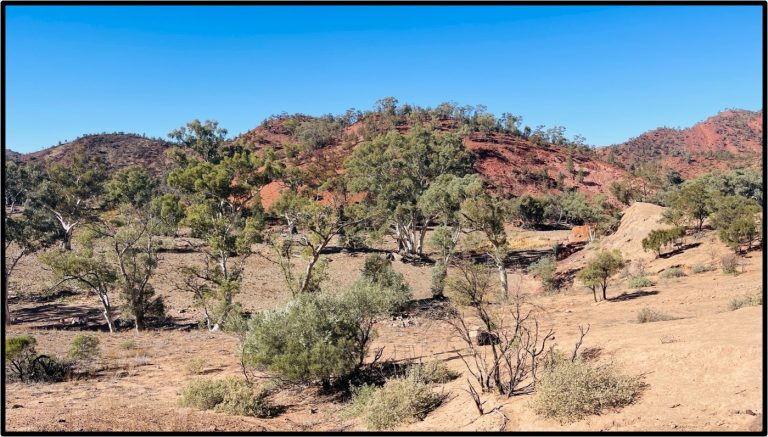
Photo submitted by scholar Zoha Shakir from Pakistan.
Caption: At first, I saw rugged mountains and ancient rocks. Through Adnyamathanha eyes, I came to see something far greater: a living landscape where culture, history and nature exist as one.
Excerpt from reflection: Standing in Brachina Gorge, as we were guided across Adnyamathanha Country, I realised I was not simply looking at mountains, trees and ancient rocks. I was standing in a place where every ridge, gorge and pathway carries stories, knowledge and responsibility. What appeared to be a beautiful landscape gradually became something much deeper: a living classroom where culture, history and nature exist as one.
Coming from Pakistan, this experience resonated deeply with me. Walking on Adnyamathanha Country challenged me to think differently about the relationship between people and the environment. I learnt that resilience is built through understanding the landscape, respecting its limits and valuing knowledge passed down through generations. This knowledge does not replace science; it strengthens it.
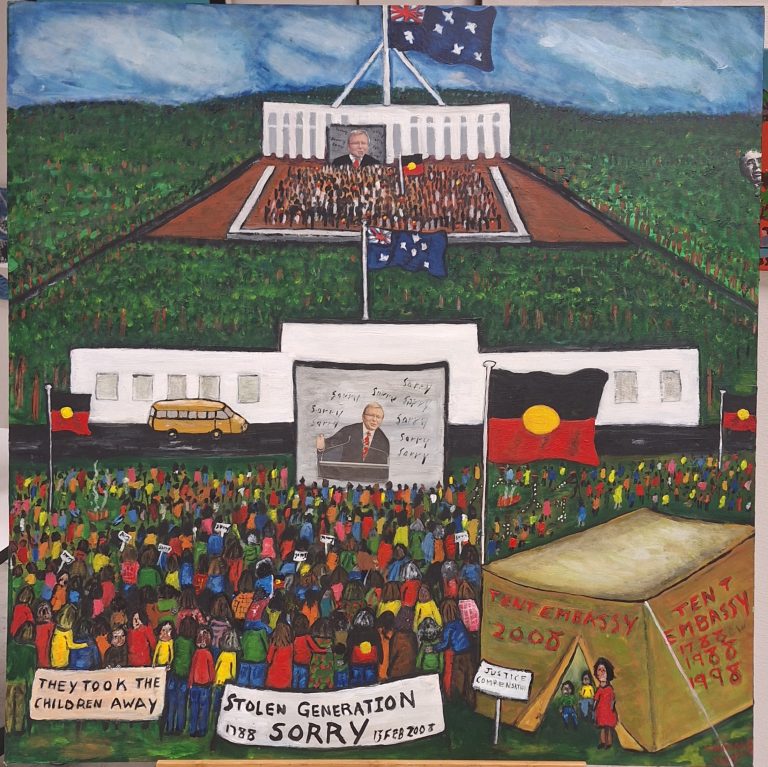
Photo submitted by Sri Lankan scholar Kirithikka Baherathan.
Caption: This photo captures a painting by Aboriginal artist and activist Sandra Saunders depicting the National Sorry Day. It was captured by my lens on 18 February 2025 at an exhibition held at the Flinders University Museum of Art.
(Used with the permission of Flinders University Museum of Art.)
Excerpt from reflection: Before starting my journey to Australia, I knew little about the First Nations of this land and their history. I had a few instances in my early days in Australia where I learnt about Aboriginal art and culture, but this photograph taught me something very different in their history. This was my first experience where I learnt about the Stolen Generation and a part of the recent history where an entire nation came together for reconciliation. As a scholar coming from the war-torn nation of Sri Lanka, this learning felt very personal, with pain, resilience and most importantly tremendous hope for building a future together.
This painting and the story behind it have shaped my perspectives of the people of Australia in their unity to thrive together for a better nation, by not ignoring the past, but sharing accountability for the occurrences and committing to acknowledgement of the custodians of the land.
Cover photo – Scholars from left to right: Winner of the competition Rajeeka Ranathunga Jayasekara Koralalage, Runners-up Jyoti Ghimire, Md Ahsanul Kabir and Nadunie Thathsaranie Wanigasinghe.