

Alumnus improving access to education for people with disability in Mongolia
Posted: 25 February 2026
Alumnus Bilguun Sergelentsogt from Mongolia recently completed a Master of Inclusive and Specialised Education at Flinders University with the support of an Australia Awards Scholarship.
Bilguun was featured as the ‘face’ of the Australia Awards promotions in Mongolia for study commencing in 2027. We caught up with him to ask about his Scholarship journey, how it has affected his personal and career growth, and how he intends to use the knowledge he gained from his Scholarship to support Mongolia’s development.
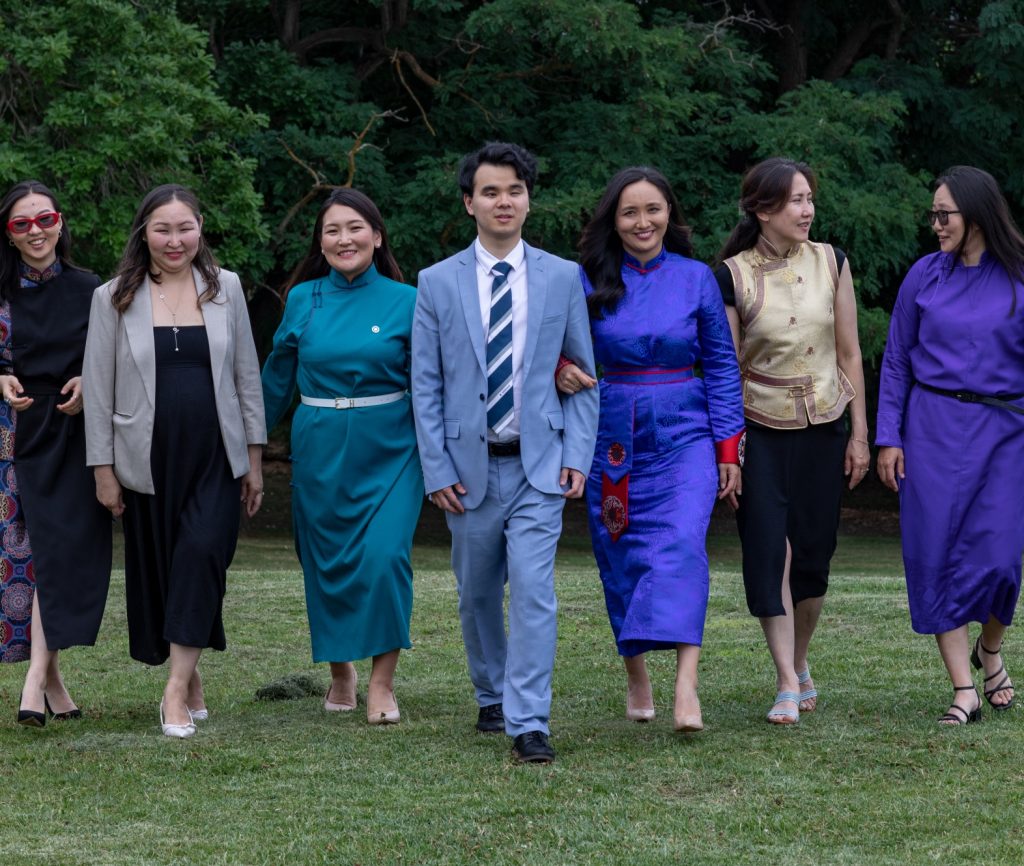
Bilguun (middle) photographed with other Australia Awards scholars from Mongolia.
Why did you apply for an Australia Awards Scholarship?
My decision to apply for the Australia Awards Scholarship was born out of a necessity that was both deeply personal and urgently professional. Growing up in Mongolia with a visual impairment, my path to becoming a teacher was fraught with barriers that my sighted peers never had to face. I vividly remember my high school years as a time of constant improvisation; most of my teachers, though well-intentioned, lacked any formal training on how to support a student who could not see the chalkboard. Moreover, I studied in a segregated setting and often experienced discrimination as well as gatekeeping from other students and teachers when I attempted to enrol in mainstream schools in Mongolia.
Professionally, I recognised a critical vacuum in our national education system. While the Mongolian Ministry of Education introduced an ambitious all-inclusive education policy in 2022, the reality on the ground was starkly different. We have a policy that allows disabled students into regular schools, but we lack the ‘human infrastructure’—the experts, the specialised curriculum and the trained educators—to make that inclusion meaningful. Since the 1990s, teacher preparation in specialised needs has largely remained stagnant. I applied for this Scholarship because I refused to be a bystander. I chose Flinders University in Australia specifically because of its prestigious reputation in disability studies and its 2-year master’s degree program. I didn’t just want a degree; I wanted a comprehensive, research-based blueprint to help me rebuild the inclusive education sector in Mongolia.
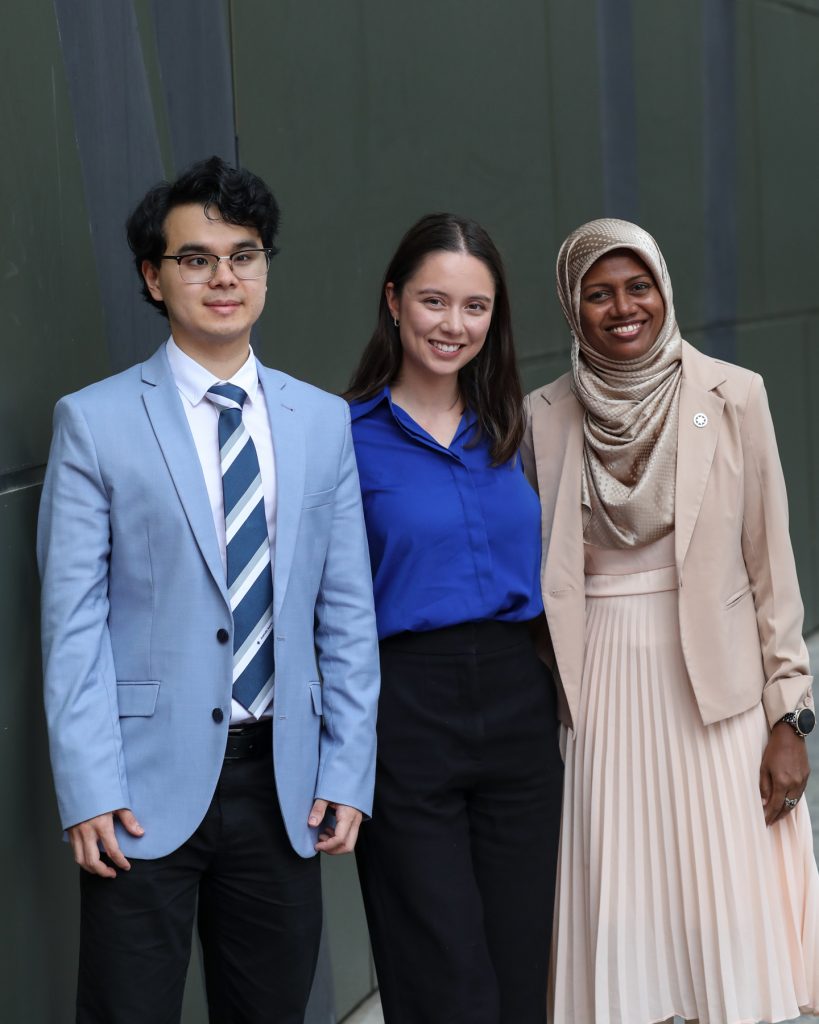
Bilguun (left) pictured with disability advocate Charlotte Young (middle), with scholar at the time Halida Mohamed Mahroof (right) from Sri Lanka at the 2024 Scholars Symposium in Adelaide.
How did your Australia Awards Scholarship contribute to your personal and professional growth?
The Scholarship was a transformative catalyst for my growth, pushing me far beyond the boundaries of a traditional classroom teacher. Professionally, the Master of Inclusive and Specialised Education at Flinders University provided me with the theoretical ‘why’ behind the ‘how’. I moved from teaching based on intuition to teaching based on evidence-based research. One of the most pivotal moments was participating in the Australia Awards – South Asia & Mongolia Scholars Forum in Canberra. This platform allowed me to network with global leaders and fellow scholars from diverse backgrounds. It challenged me to think of disability not as a medical deficit to be fixed, but as a human rights issue that requires systemic reform. I learnt how to analyse education through the lenses of economy, culture and legislation—perspectives I had never fully considered back home.
Personally, the Scholarship gave me the gift of independence. Navigating a foreign country as a person with a visual impairment was a daunting prospect, but it forced me to develop a level of self-advocacy and resilience I didn’t know I possessed. The Scholarship didn’t just teach me about specialised education; it taught me how to lead. I realised that my lived experience as a person with disability is not a hindrance, but a unique expertise. I emerged from the program not just as a more skilled English as a Second Language teacher, but as a potential policymaker who is capable of communicating with international institutions and government bodies to initiate large-scale social change.

Bilguun (front row, right) participating in the 2025 Disability Sector Connect Program with other scholars from South Asia and Mongolia.
University aside, what was your life in Australia like?
Life in Australia was a revelation in terms of what a truly accessible society looks like. Outside the lecture halls of Flinders University, I spent my time immersing myself in the ‘sensory geography’ of Adelaide. For a person with a visual impairment, Australia offered a level of autonomy that was liberating. I marvelled at the consistency of tactile paving on the sidewalks, the audible signals at every pedestrian crossing and the widespread availability of screen-reading technology in public libraries. These may seem like small details to many, but for me they represented a profound respect for the dignity of disabled individuals.
Beyond the physical environment, the social culture was incredibly welcoming. I engaged in community events, took part in volunteer activities, and joined international groups where I could engage with diverse international perspectives and local culture. I made it a point to travel and experience the Australian landscape: I have travelled to different cities, beaches and mountains with friends from my university. These experiences broadened my understanding of ‘inclusive culture’. It wasn’t just about schools; it was about how a society integrates all its members into the fabric of daily life. I often found myself taking mental notes on how public transportation and community services were structured, dreaming of how I might one day advocate for similar standards of accessibility in the streets of Ulaanbaatar.

Bilguun at his graduation ceremony, proudly holding his Australia Awards certificate.
Having now returned to Mongolia after graduating, how do you plan to contribute to your home country’s development?
I plan to apply my Australia Awards experience in three main ways. First, I will support students with disability by developing and delivering English language and computer skills programs, with a strong focus on assistive technology. This will help improve their academic performance, digital literacy and future employment prospects, particularly for students in mainstream schools and remote areas.
Second, I will contribute to teacher professional development by organising training programs for teachers in general education schools. Drawing on the inclusive pedagogical approaches learnt in Australia, I will provide practical, research-based guidance on teaching students with diverse learning needs. This will help improve teacher attitudes, teaching effectiveness and classroom inclusivity across the education system. These skills are critically needed in Mongolia, where inclusive education is still at an early stage and where many teachers lack the preparation to support students with disability effectively.
Third, I will strengthen the role of non-government organisations and evidence-based policymaking by supporting disability-focused organisations in project implementation and by conducting empirical research on inclusive education in Mongolia. The resulting data and research findings will help address existing knowledge gaps, inform policy discussions, and guide future interventions by schools, non-government organisations and government institutions.
What advice would you give to anyone thinking of applying for an Australia Awards Scholarship?
To anyone considering this journey, particularly those from the disability community, my advice is simple: Your perspective is your greatest strength. When you write your application, do not shy away from the challenges you have faced. Instead, frame those challenges as the foundation of your expertise. The Australia Awards committee is looking for leaders who understand the ‘pain points’ of their home country and have a clear, realistic vision for how to fix them. Be specific about why a particular Australian institution is the right fit for your goals; for me, Flinders University was the only choice because of its specific focus on my field.
Secondly, focus heavily on your Return-to-Work Plan. The Scholarship is not an end in itself; it is a bridge to your future contribution to your country. Think deeply about how you will translate ‘Australian excellence’ into your local context. Mongolia, for instance, has different cultural and economic hurdles than Australia, so you must show that you are capable of adapting what you learn to fit your home environment. Finally, work on your English proficiency early and relentlessly. English is not just a subject; it is the tool that will allow you to communicate your ideas on a global stage and bring back the knowledge your country so desperately needs. Believe in the value of your own story—it might be exactly what your country needs to hear.